
Valletta fits inside a rectangle roughly 1,000 metres long and 600 metres wide, and you can walk from City Gate to the sea wall at the far end in about fifteen minutes. Almost all of it went up between 1566 and 1573: bastions, gridded streets, eight national inns, a church, a hospital. The Order of St John had just survived a four-month siege, decided the peninsula they had fought over needed to be a fortress in its own right, and built one in seven years. What follows walks that build in roughly the order it happened, which is also the order that makes the most sense on foot.
Start across the harbour, where the Order started
Fort St Angelo (across Grand Harbour, about ten minutes on foot from the ferry landing) was the Order's headquarters before Valletta existed. Jean Parisot de Valette ran the 1565 defence from here, and the upper part of the fort is still held by the Sovereign Military Order of Malta under agreement, while remaining open to visitors. Heritage Malta runs it: €10 adult, €6 youth, senior or student, €4 child 6–11, with audio guides in eight languages, parking, a café and a shop. Groups are comfortable here with one exception: the upper fort is reached only by steps, so anyone who cannot manage stairs will see the lower levels and the harbour views and stop there.
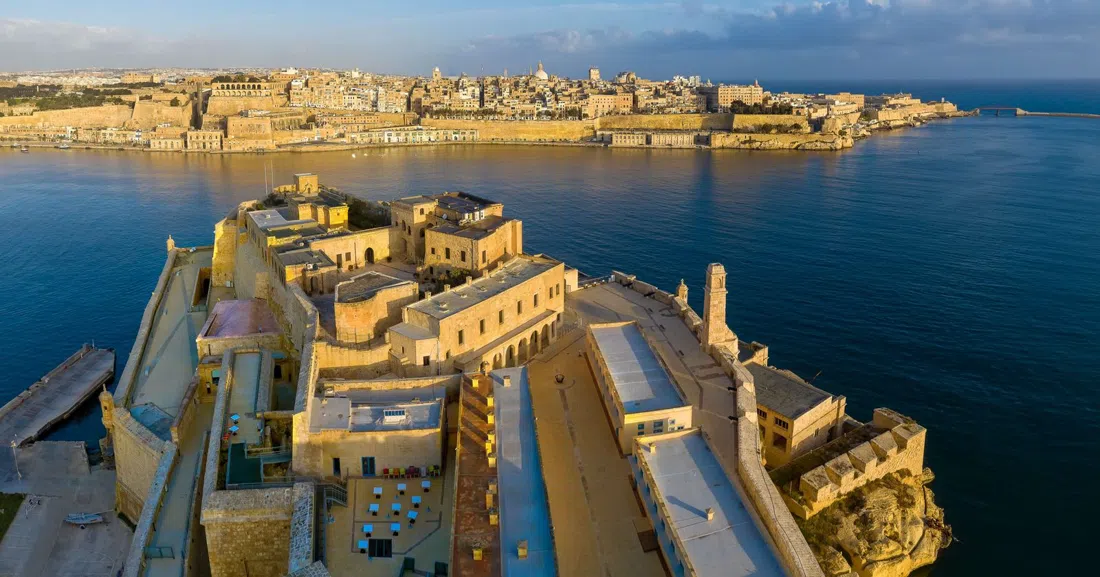
Getting across is part of the point. From Upper Barrakka Gardens, the lift drops 58 metres to the waterfront in under a minute, the ferry crossing takes about five, and you land looking straight back at the wall of stone the Knights raised afterwards. Do this on your first morning if you can. You are standing where the Order stood before the city existed, and everything else in this article is what they built next.
The first thing they finished
Church of Our Lady of Victory (a two-minute walk inside City Gate, on the small square above Castille Place) was the first building completed in the new city, paid for personally by de Valette, who was buried in it before St John's Co-Cathedral existed. Entry is free with a voluntary donation, and it is open year-round. Din l-Art Ħelwa restored it, and the interior is genuinely small: a couple can stand in it for ten minutes and see everything, a party of thirty cannot. Split larger groups and send them in waves, and accept that concerts and ceremonies can close it at short notice with no warning online. Chronologically, everything else on this walk follows this room.
The land front, and the cavaliers behind it
The peninsula's weak side was always the landward one, so the military engineer Francesco Laparelli put the heaviest work there: a wall across the neck of the peninsula and two cavaliers, raised gun platforms set back from the bastions so their artillery could fire over them.
One of those cavaliers is now Spazju Kreattiv, St James Cavalier (Castille Place, beside the gate), converted in 2000 into Malta's national centre for creativity. Wandering the building is free; gallery shows and cinema screenings are ticketed separately at low single-digit euro prices. It opens Tuesday to Friday 09:00–21:00 and Saturday and Sunday 10:00–21:00, closed Mondays. Go for the fabric rather than the programme: thick-walled gun galleries reused as exhibition rooms are the clearest case in the city of Knights' engineering still doing a job instead of being roped off.
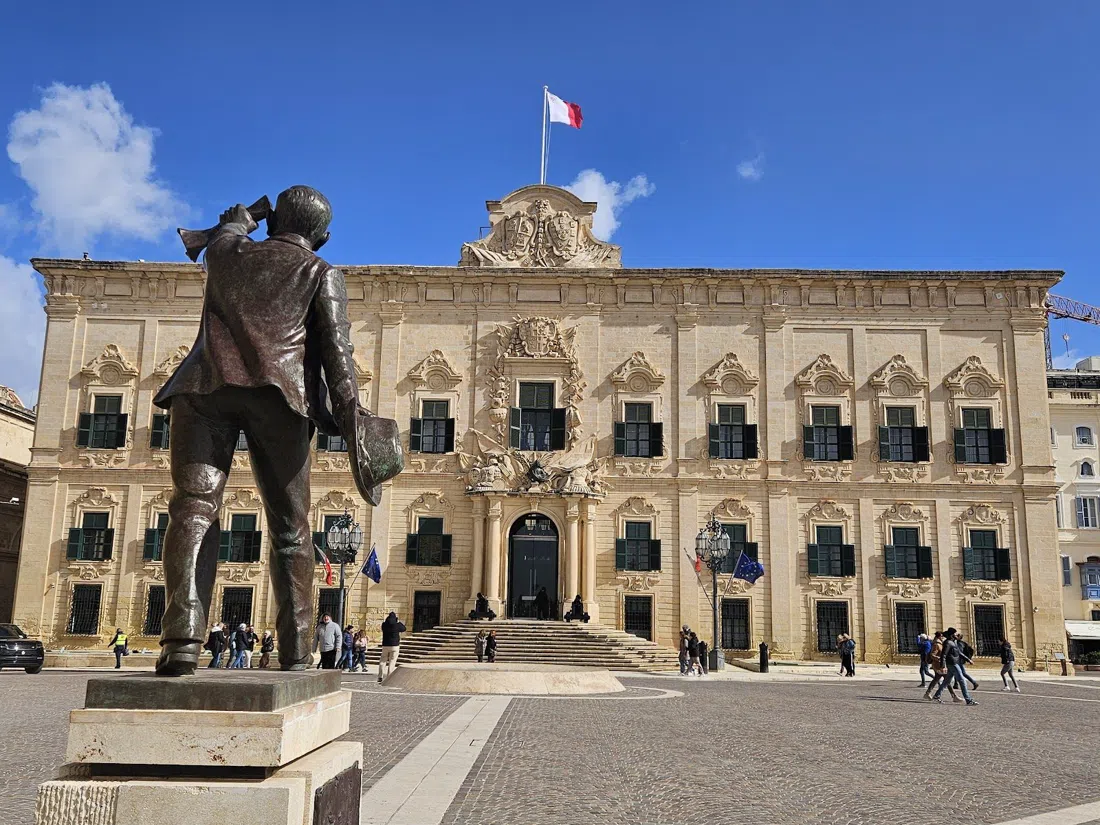
A hundred metres on stands Auberge de Castille (Castille Place, at the highest point of the grid), the inn of the Spanish and Portuguese langue and the most confident piece of architecture the Order produced here. Know before you walk up that it is the Office of the Prime Minister and there is no public interior access. You photograph the facade from the square, which is level, open and free. You look, you do not go in.
Behind it, the Saluting Battery (Upper Barrakka Gardens, 150 metres from Castille Place) was built into the enceinte in 1566 as part of Laparelli's original design and still fires at noon and 16:00, Monday to Saturday. It is the oldest saluting battery still in operation anywhere. Tickets are €6 adult, €3 child 5–15, free for members, with a discount for groups of ten or more; guided tours in English run hourly from 10:15, the last at 16:05. Arrive a quarter of an hour before a firing, because the terrace fills. That terrace, above the battery, is free to stand on and gives you the whole of what the Knights built in one sweep: harbour, opposite bastions, the grid falling away behind you.
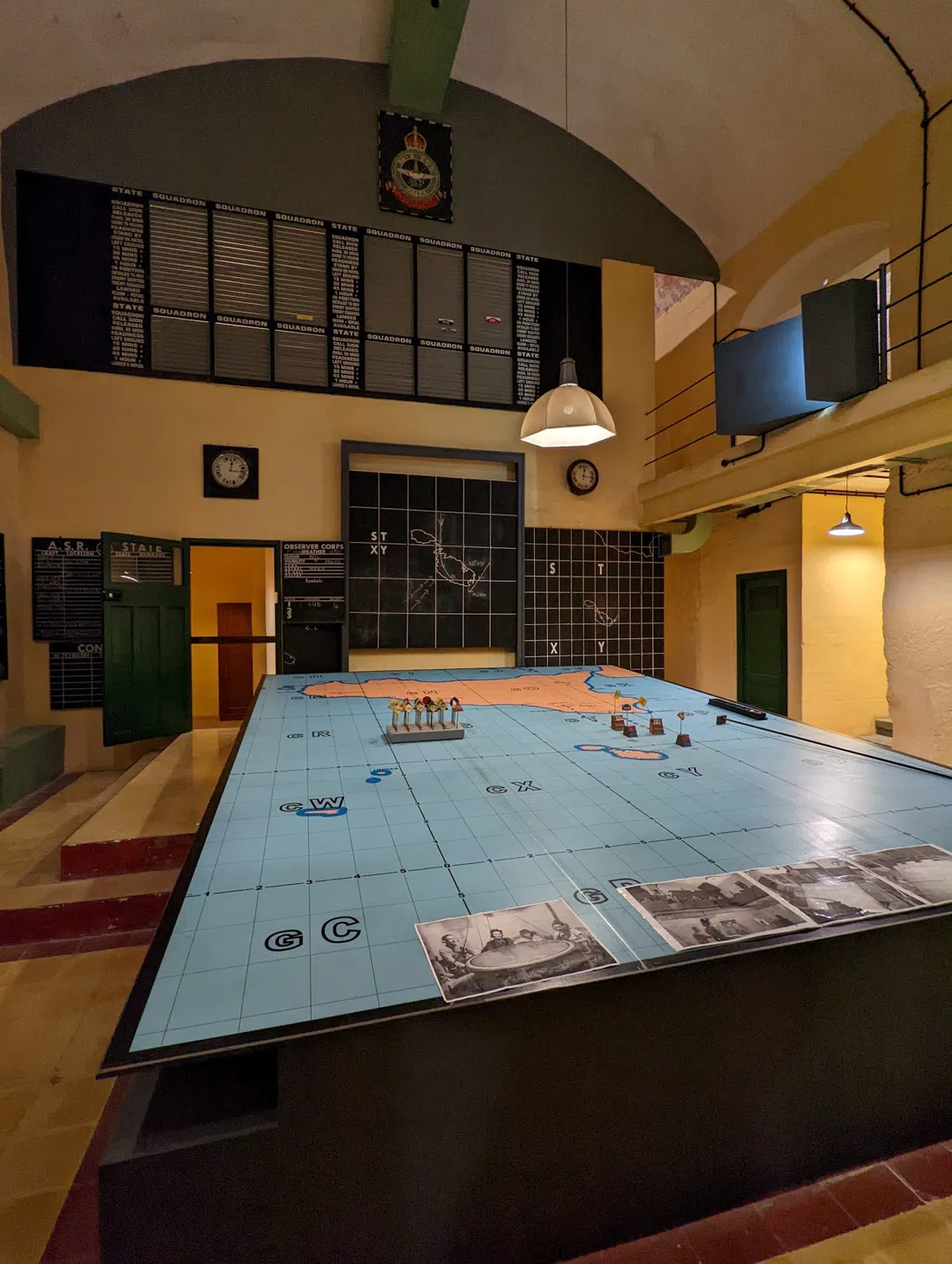
Directly below it, the Lascaris War Rooms (entered from the foot of Upper Barrakka) tunnel through the Lascaris Bastion, named for the Grand Master who paid for it, and were cut out again in the Second World War as the Allied command centre for the central Mediterranean. Adult entry is €20, seniors €19, children 5–15 €7, family €40, card only, and no cash is accepted at the door. The ticket includes guided tours and film screenings, and premium guided tours leave daily at 10:00, 13:00 and 14:00 from the Saluting Battery above. The story told inside is 1940s, not 1560s. The Knights' contribution is the rock itself, which is exactly the argument for going: the fortifications were still earning their keep 370 years later.
The seaward end, and the 31 days that made the city necessary
Walk the length of Republic Street, about 1.1 kilometres, level, roughly fifteen minutes without stops, and you reach Fort St Elmo and the National War Museum (the tip of the peninsula). This is where the whole story starts. The fort held for 31 days in 1565 and its garrison bought the Order the time it needed to survive the siege and then build the city behind it. Heritage Malta charges €10 adult, €7.50 youth, senior or student, €5.50 child 6–11. Two things to check first: the First World War display in Section 4 is closed until further notice, and on days when the In Guardia costumed drill takes over the parade ground, general admission only begins from midday. That drill is the natural set-piece for a coach party and the natural thing to avoid if you want the ramparts quiet. Either way, look up the date before you commit a morning.
Eight nations, eight inns
The Order was divided into langues, national sections, and each kept its own inn, an auberge, inside the grid. Two of them now hold national collections, which makes them the easiest way to get inside the Knights' domestic architecture.
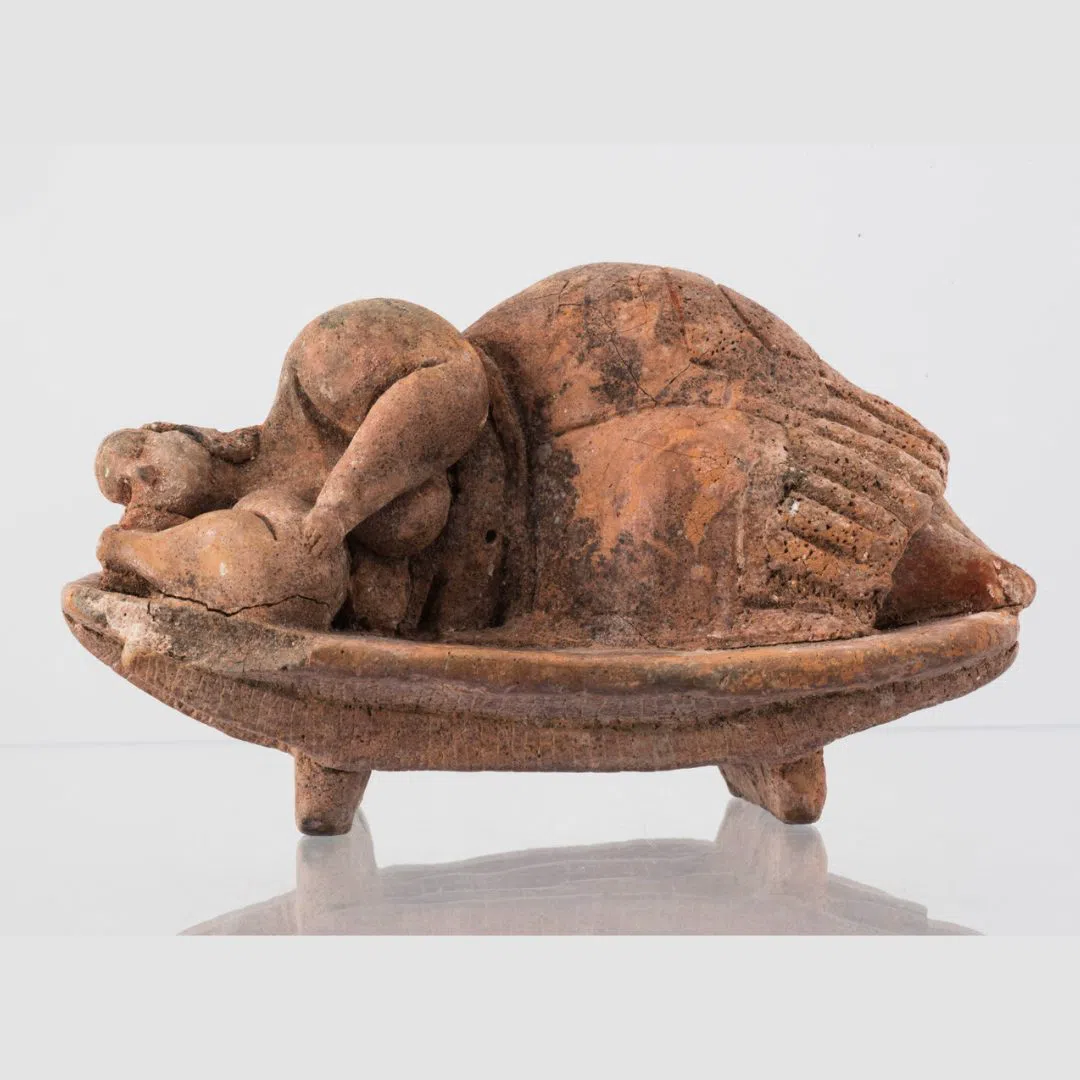
National Museum of Archaeology, Auberge de Provence (Republic Street, roughly halfway along) is €5 adult, €3.50 youth, senior or student, €2.50 child 6–11. That is the lowest admission of anything serious in Valletta, and the auberge interior that has survived most intact. Even if Neolithic figurines are not your subject, go up to the Gran Salon on the first floor; that room is the ticket.
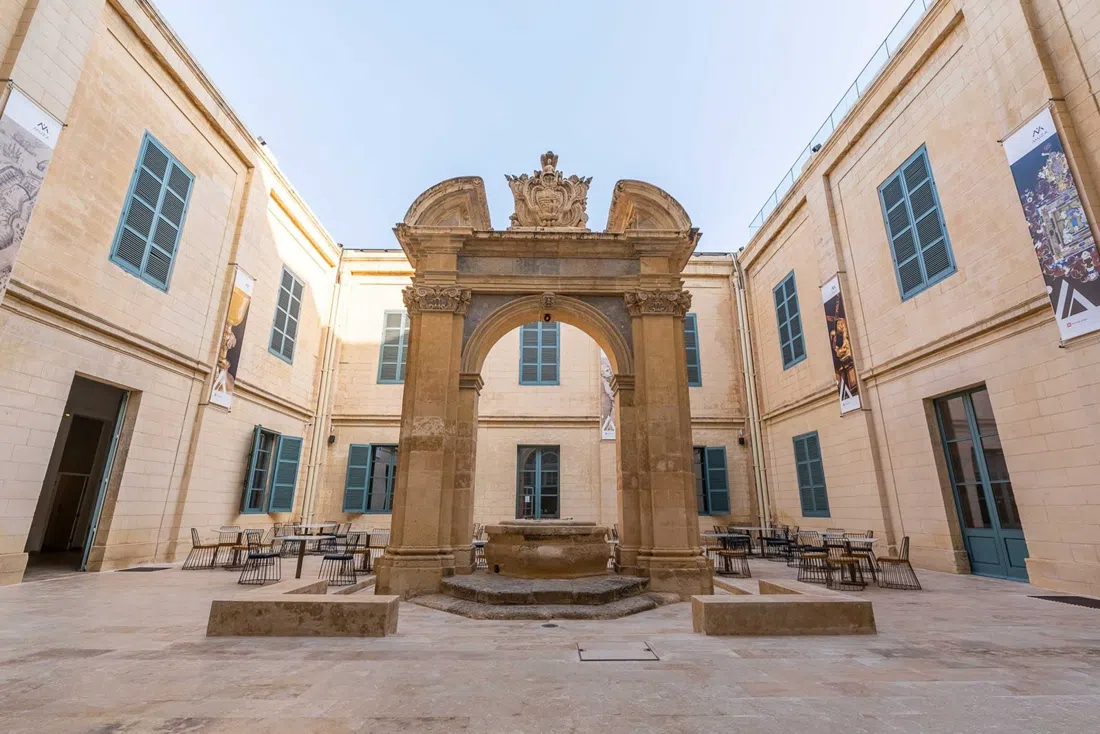
MUŻA, the National Museum of Art in the Auberge d'Italie (Merchants Street, three minutes downhill from Castille Place) is the Italian knights' own inn holding the national art collection, at €10 adult, €7.50 youth, senior or student, €5.50 child 6–11. It runs 10:00–18:00 from March to October and closes on Tuesdays in January and February, so a winter visit needs checking. There is lift access and enough circulation space for a group to move without bottlenecking, and guided tours and school visits are bookable by phone or email. The building is half the exhibit.
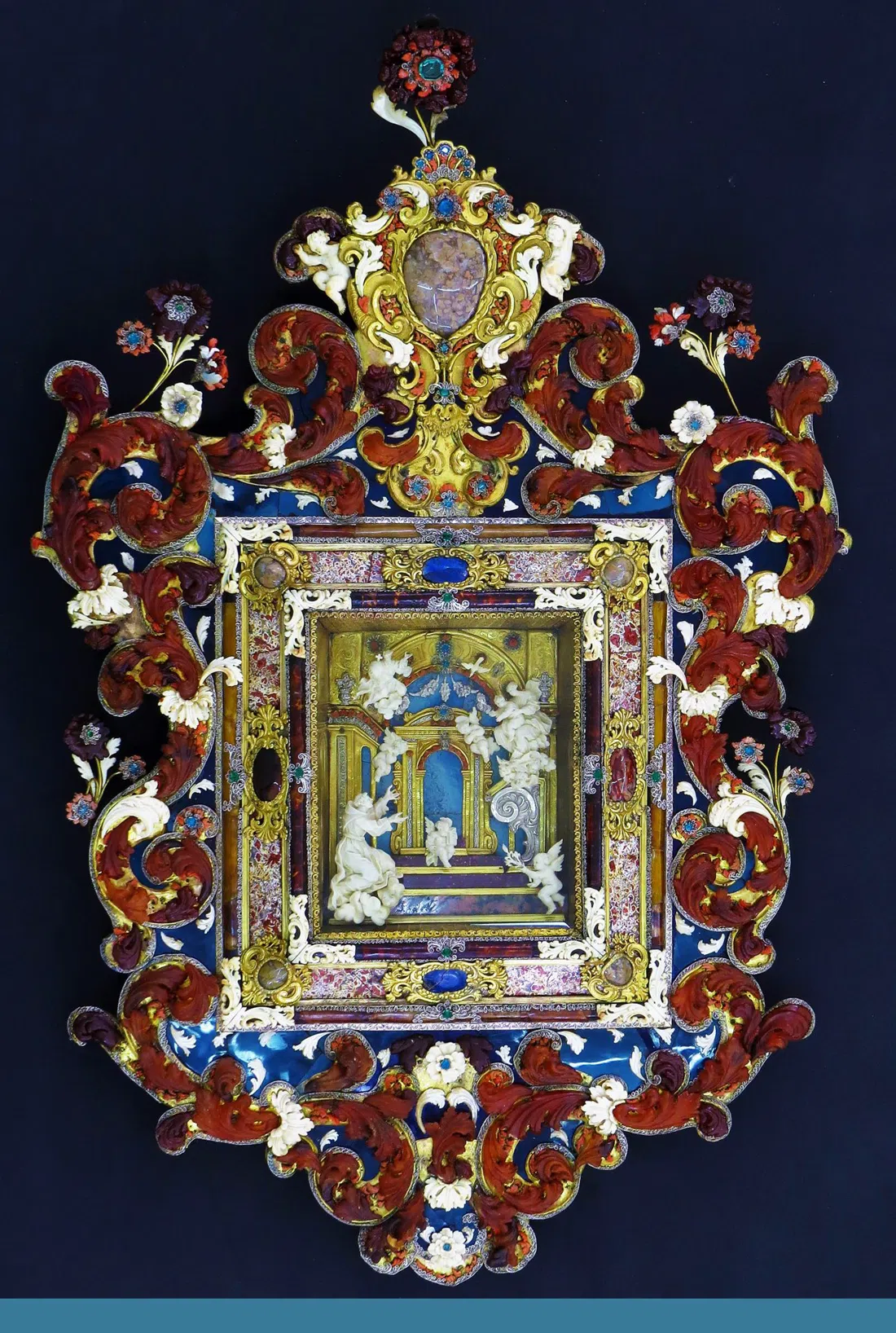
Across the small square from Our Lady of Victory, the Church of St Catherine of Italy is free and takes minutes. It is a compact octagon, still an active church for Malta's Italian community, and roughly Mon–Sat 09:00–17:00, short hours worth confirming rather than crossing town on faith. Its value is structural: it is the only Hospitaller church still attached to its original auberge, next door to the Auberge d'Italie, which makes it the clearest surviving picture of how a langue actually lived, inn and chapel at one address. Heritage Malta and the Archdiocese are folding it into the MUŻA visit, so pair the two. Small groups only; a full coach will not fit.
One chapel per langue
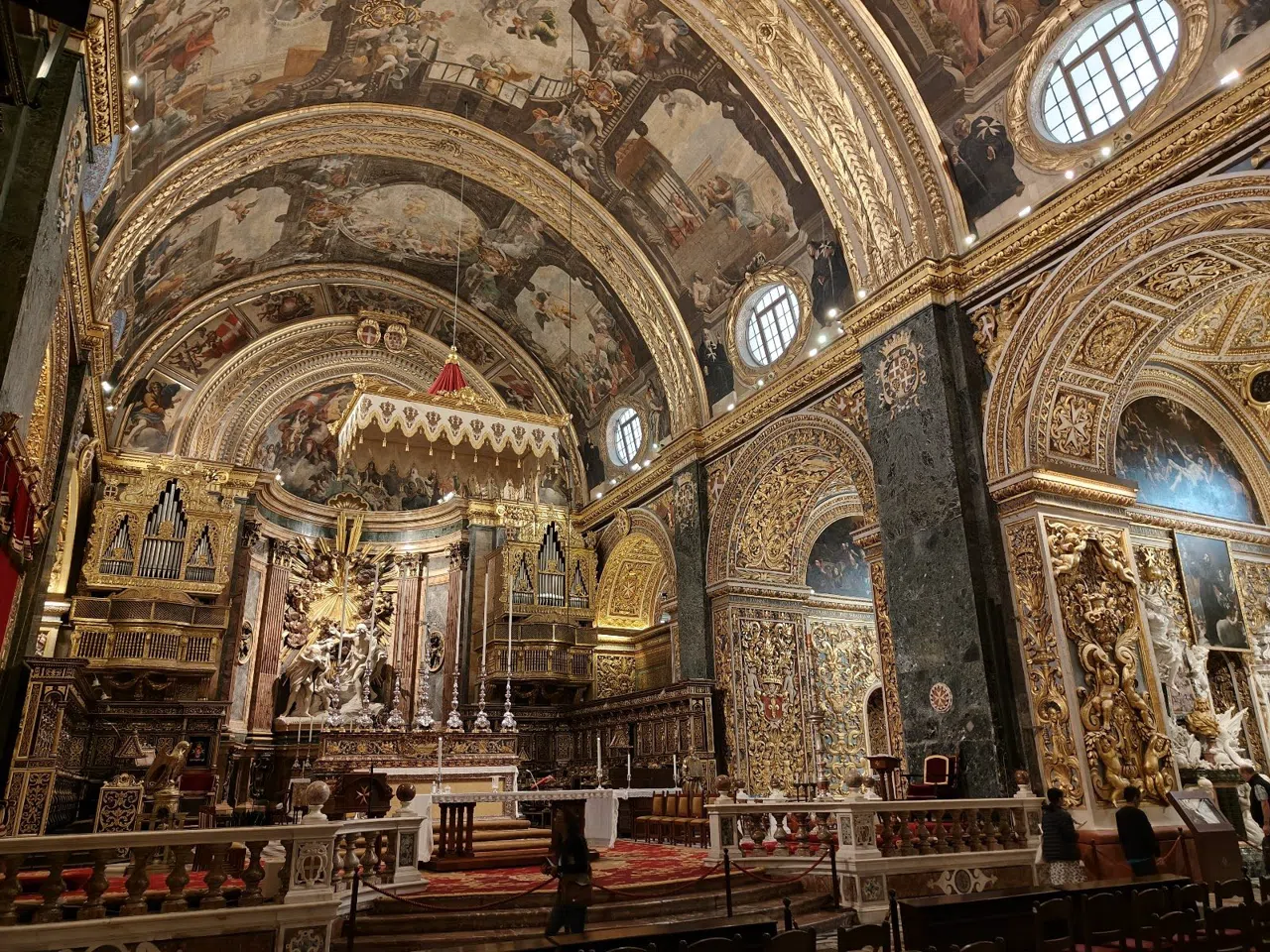
St John's Co-Cathedral (St John Street, a few steps off Republic Street) is the single building here you should not skip. Each langue funded and decorated its own side chapel, which means the nave reads as a league table in gold leaf, money spent to out-do the inn down the road. Adult entry is €15, €12 for seniors and students, under-12s free with an adult, and the audio guide is included; the belfry tour is €5 more, paid at the door. The Oratory off the nave holds the cathedral's Caravaggio canvases when they are not away for conservation.
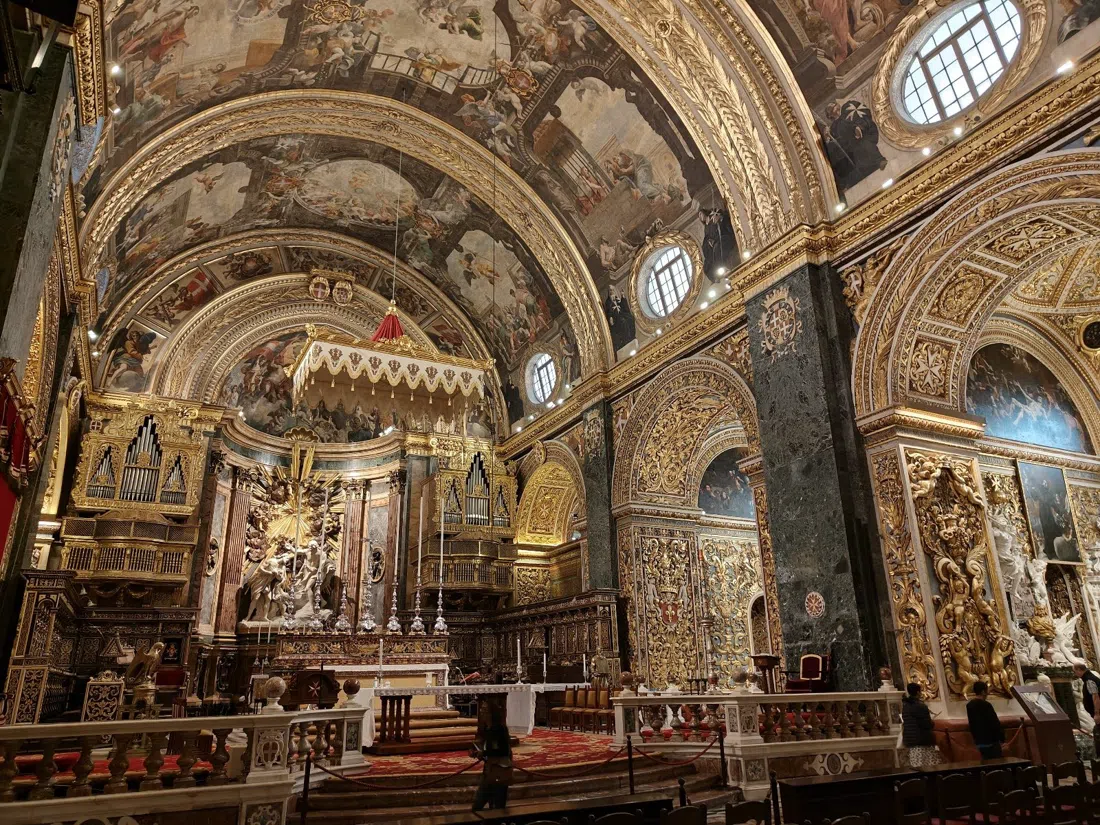
The practical constraints are tighter than most visitors expect. It closes on Sundays and public holidays. The Foundation staggers or caps numbers in the main nave by group size, so pre-booked slots are effectively mandatory for coaches and sensible for anyone else in high season. Last admission is 16:00, which leaves you 45 minutes, and 45 minutes is not enough. Come in the morning and give it ninety.
The Palace, and the paperwork behind the stonework
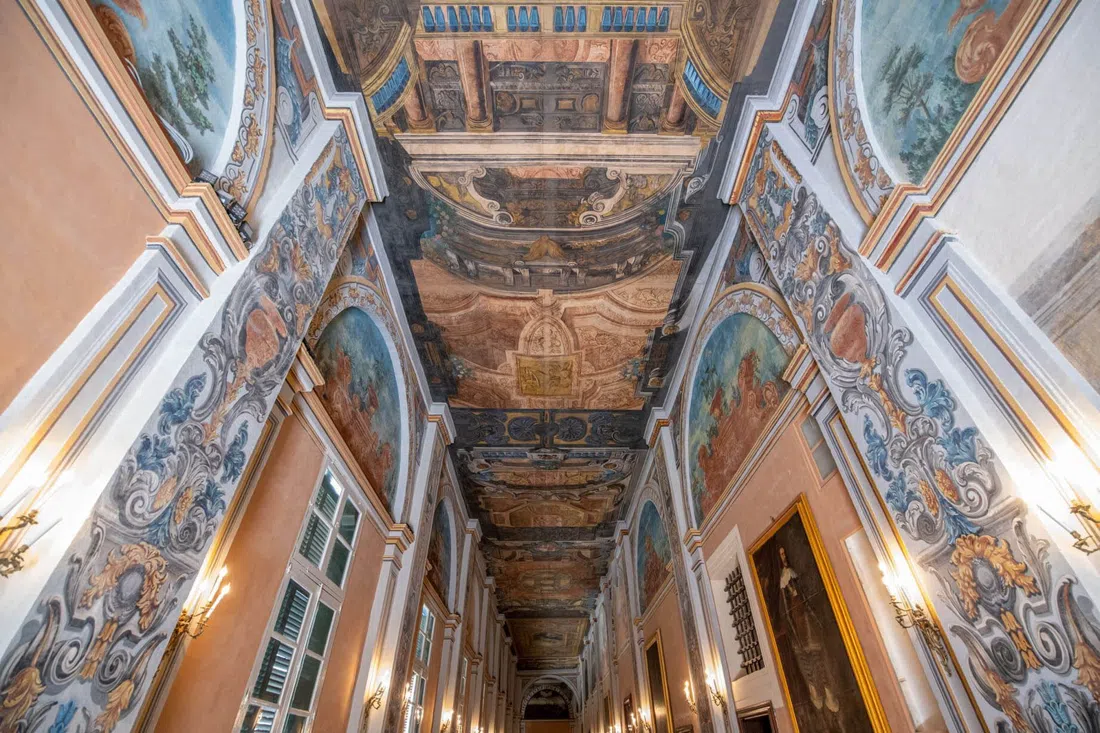
Grand Master's Palace (Palace Square, on Republic Street) reopened in 2024 after a €40 million restoration that opened nine halls of the Grand Master's summer apartment to the public for the first time. Tickets are €12 adult, €10 youth or senior, €8 child 6–11, with infants and Heritage Malta members free; buy a timed slot online rather than joining the Republic Street queue. Two caveats: the Throne Room is closed until further notice, and on scheduled Wednesdays the State Rooms do not open until 13:30. The Palace Armoury stays open on those mornings, so the visit is not wasted, it just inverts.
Fifty metres away on Republic Square, the National Library of Malta (the Bibliotheca) is free to walk into with no booking, though you will need photo ID for a visitor tag and researchers work in a separate area. Grand Master de Rohan founded it in 1776 and it still holds the Order's archives from the Middle Ages to 1798, the administration behind everything else you have walked past. Keep groups small and quiet. It closes at 13:15 on Saturdays and every afternoon in summer, from 16 June to 30 September.

Hospitallers first, soldiers second
The Order was a hospitaller order before it was a military one, and The Malta Experience and Sacra Infermeria (lower Valletta, Mediterranean Street) is the building that proves it, a hospital ward where patients were fed off silver plate. The combined ticket is €20 adult, €15.50 student, €9 child, with the Sacra Infermeria tour included, shown in a purpose-built theatre inside the conference centre with 17 language channels on headsets. That makes it the simplest booking in the city for a large mixed-language party. The two halves are uneven: the 45-minute film is unashamedly old-school, and the hospital tour is the reason to come. Weekend hours are shorter, roughly 11:00–14:00.
The city the seven years made possible
The Order kept building long after 1573, and two places show what that looked like. Teatru Manoel (Old Theatre Street, 150 metres off Republic Street) was commissioned by Grand Master Manoel de Vilhena in 1731 and finished in ten months, evidence that the seven-year city was a method rather than a one-off sprint. Daytime guided tours run Monday to Saturday with times shifting by season, and Tuesdays add an actor-led route through the boxes and private salons. Tickets are modest, roughly €5–12 depending on the tour; closed Sundays, and groups book direct with the box office.

Casa Rocca Piccola (Republic Street, towards the lower end) was built for a knight of the Italian langue and is still lived in by the de Piro family. Guided tours run hourly from 10:00 to 16:00 daily except Sundays, in the low-to-mid teens in euro per adult, with the guided tour or an app audio guide included. Tour sizes are capped and the rooms are small, so book ahead and expect a large party to be split. It is the one place on the grid where the Knights' city stops being a museum, which makes it a better fit for couples and pairs than for a coach.

Practical notes
Malta uses the euro. Cards work almost everywhere, the Lascaris War Rooms take nothing but cards, and the two free churches and the library run on voluntary donations and visitor tags, so carry a few coins and photo ID anyway.
Getting in and around: the island's bus network funnels into the terminus just outside City Gate, and once inside you walk. Republic Street runs level along the ridge; every cross street drops towards a harbour, several in flights of steps, which is the thing to plan around if anyone in your party has limited mobility. The Barrakka Lift and the harbour ferry together get you to Fort St Angelo and back inside two hours plus however long you spend in the fort.
Timing: two full days covers everything above without rushing. Day one, the land front: Our Lady of Victory, St James Cavalier, the Castille facade, the Saluting Battery for the noon firing, then the war rooms below and MUŻA with St Catherine after. Day two, the grid and the sea: St John's early, the Palace and library at midday, the Auberge de Provence, Casa Rocca Piccola, Fort St Elmo, and the hospital at the bottom of the hill. Add a half-day across the water for Fort St Angelo. Note the pattern in the closures: St John's, Casa Rocca Piccola and Teatru Manoel all shut on Sundays, and MUŻA on winter Tuesdays, so a Sunday in Valletta is a walls-and-views day, not an interiors day.
Budget: the full list of paid sites adds up to roughly €130 per adult. Four of them (the Palace, Fort St Elmo, the Auberge de Provence and Fort St Angelo) are Heritage Malta's, so if you intend to do all four, check what their multi-site options cost before buying singles. Trim by dropping the war rooms and the audio-visual show, both €20, if the Second World War is not your interest; keep St John's at €15 whatever else goes. For where to base yourself, the compact grid means almost any address inside the walls puts you within ten minutes of everything here. Compare rates on the Valletta hotel search, and see the Valletta guide for eating, harbour trips and the rest of the city.